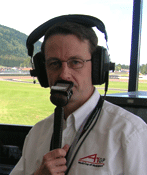
Looking back, I suppose the best I ever raced against was Mika Hakkinen; his record speaks for itself, a double World Champion and one of the only drivers truly respected by Michael Schumacher. Of course, he was yet to reach those dizzy heights when I raced him. We were both competing in the first season of Formula Vauxhall Lotus in the UK, and Formula Opel Lotus as it was known on its European forays. Mika was teamed up with Allan McNish at Dragon Motorsport with full Marlboro backing, and he was another Finnish phenomenon following in the footsteps of Keke Rosberg and JJ Lehto who had swept away the opposition in Formula Ford 2000 and then in British F3. Mika had a similar flair to JJ; they both had remarkable car control and could use it in flamboyant ways and yet still be fast. There I was, an instructor at the racing school at Brands Hatch, trying to instil in my pupils the benefits of smoothness and keeping the car moving forwards without unnecessary tyre scrub, while seeing both these crazy Finns driving their cars at bizarre angles with fistfuls of opposite lock. To be honest, I didn’t see that much of Mika; he was usually further up the road somewhere, but I can still remember the shake of the head and look of wonder on my best pal’s face when we compared notes after the race, and he was relaying the story at the front of the grid. So we have one ingredient for the great driver; car control, but that in itself is not enough. One of the best drivers for car control I’ve ever sat with is Tim Jones, son of legendary Brands Hatch commentator Brian. Tim grew up on the skip pan at Brands, and his car control was awesome. Riding around Paddock Hill Bend in a road going Ford Escort Cosworth, he had that thing almost going backwards he was so sideways and yet it was always beautifully under control and when he wanted it to point up the hill towards Druids, he’d apply some deft foot and hand coordination and we’d be sailing straight on once again. Perhaps he was born a few years too early; the drifting scene would surely have been his arena. And he was fast in a Formula Ford, battling for wins with the likes of Damon Hill and Mark Blundell. So why didn’t he make it all the way to F1? Lack of budget and opportunity is the obvious answer, and anyone who has watched the lower ranks of motor racing will have stories of the ones who should have made it but never did. So is luck a part of the great driver’s armoury? Yes and no. Johnny Herbert was another of Tim’s contemporaries and he had no money at all. But what he always had was utter self belief when he was in a racing car, and that inspired people to support and help him. He was given opportunities by Mike Thompson at Quest, and later by Eddie Jordan in F3 and he delivered on every one. That self confidence must have taken an awful blow following his terrible F3000 accident at Brands Hatch, but he never let it show, and went out of his way to appear bubbly and confidant no matter what situation he was in. I still feel that an uninjured Johnny Herbert could and should have been a Formula One World Champion. That he was able to enjoy such a long and illustrious career at the highest level despite lacking full movement in his ankles still astonishes me, and he’s definitely on my personal Great Drivers list. So we have flair, car control and self confidence. What about bravery? Is that different to self confidence? Yes, I believe it is and bravery on its own is not necessarily a race winning attribute; yet there are times when it matters. Driving in the wet is one of them, and I defy any single seater driver of some experience who has been mired mid-grid on a foul wet day to tell me they have not felt fear. The complete lack of visibility when spray is all around you, the inability to see the approach to a corner when you’re travelling flat out down a long straight, the need to judge your braking by when you hear other engines lift off; these are all part and parcel of racing in really wet conditions, and a certain amount of sheer bravery is required. It’s important on the superspeedway ovals in America too, where the consequence of even a minor mistake can be catastrophic. And I think it was a key part of Mansell’s success; he could take a Ground Effect car, or an active suspension car and through sheer physical bravery he could go to limits that other drivers found difficult to reach. So bravery is a factor, but it can be a hindrance too, especially in other forms of motorsport such as Touring Cars. Too much of it leads to over-driving and in a tin top that means slow laps. Drivers like Fabrizio Giovanardi and Jason Plato are brave; we can see that in some of the moves they make, but it has to be coupled with a total awareness of the limitations of the car, and the physical limits of the circuit. I have commentated on these two a great deal over the last couple of years, and their mutual respect does not surprise me. It’s as if they have an in-built radar system that pinpoints every extremity of their own car as well as those of the cars around them. They create in their minds a kind of web that encapsulates their car and they can be sensitive to any vibration in that web as they look to rub alongside another rival. Not all Touring Car drivers have that ability; they’re the ones who are too timid one week and overly aggressive the next, either victim or assailant but never a regular finisher. Touring Cars is not alone in requiring that awareness and in particular the ability to position a car in exactly the right space at the right time. It’s something we’re seeing a lot right now with Lewis Hamilton. When commentating for Formula One in Cinema, I have seen how he is able to place his car absolutely precisely and force another driver to give way and yet be entirely fair in doing so. He is a natural racer; and having that ability to work space, time and distance to such a high level has to be another ingredient to add to the mix. We’re building a picture of great racing drivers, but there’s another element that can transcend almost anything else; total commitment. For me, Ayrton Senna exemplified it more than anyone, particularly in qualifying. Setting the fastest time of that session was something that mattered to him so much, you could see it burning out of his eyes as he sat in the garage, waiting for the ideal moment to attack. Under the rules at that time, qualifying was more gladiatorial, with time for a driver to see someone else improve and respond in kind. If ever there was a demonstration of the power of desire combined with faith or self belief, and their power to move mountains, then it was in watching Senna during qualifying. His commitment was absolute, and although some people smirked at his philosophical comments, surely the guy was regularly in the ‘zone’ that so many athletes and sportsmen and women strive to achieve? In a minor way I remember achieving it myself once or twice in a much more humble racing car, but that feeling of being able to do almost anything with it, to have it dancing to your tune and to be utterly lost in total focus and concentration is a very special feeling indeed. Our inventory is almost there. Checking the list, there’s flair and self confidence, an instinctive yet honed spatial awareness, an element of bravery but not too much, the odd slice of luck, and all of it is wrapped up in a parcel of total commitment. Great drivers are born AND made, and identifying them in all of the different ranks of motorsport is just part of the fun. |